


Table of Contents
uPVC Door Won’t Lock?
Here’s Why, and What to Do
A stiff or failing uPVC door is one of the most common jobs I’m called out to, and it’s also one of the most misunderstood. Here’s what’s actually going wrong, what you can safely check yourself, and when it’s worth picking up the phone, in plain English, no jargon.
First, the good news: it’s almost never the whole door
When a uPVC or composite door stops locking, most people’s first fear is that they’re looking at the cost of a whole new door. In nearly every case, they’re not. A uPVC door is made of a few separate parts working together, and when it won’t lock, it’s almost always one of those parts that has worn out, not the door itself. Replacing that one part is a fraction of the cost and can usually be done in a single visit.
So before anyone talks you into a new door, it’s worth understanding the three things that actually go wrong, because it’s nearly always one of them.
The three usual culprits
1. The multipoint mechanism
Run your eye down the edge of an open uPVC door and you’ll see a strip of metal with several locking points, hooks, rollers or bolts, spaced along it. That’s the multipoint mechanism, and it’s the single most common thing to fail. When you lift the handle, it’s this mechanism throwing all those points into the frame at once. Years of daily use wear the gearbox inside it, and eventually it starts to stiffen, then jam.
The tell-tale sign: the handle gets progressively stiffer to lift over weeks or months, or suddenly won’t lift at all. If the handle flops loosely with no resistance, the gearbox has usually gone completely. This is a replaceable part, not a new door.
2. The cylinder (the bit your key goes into)
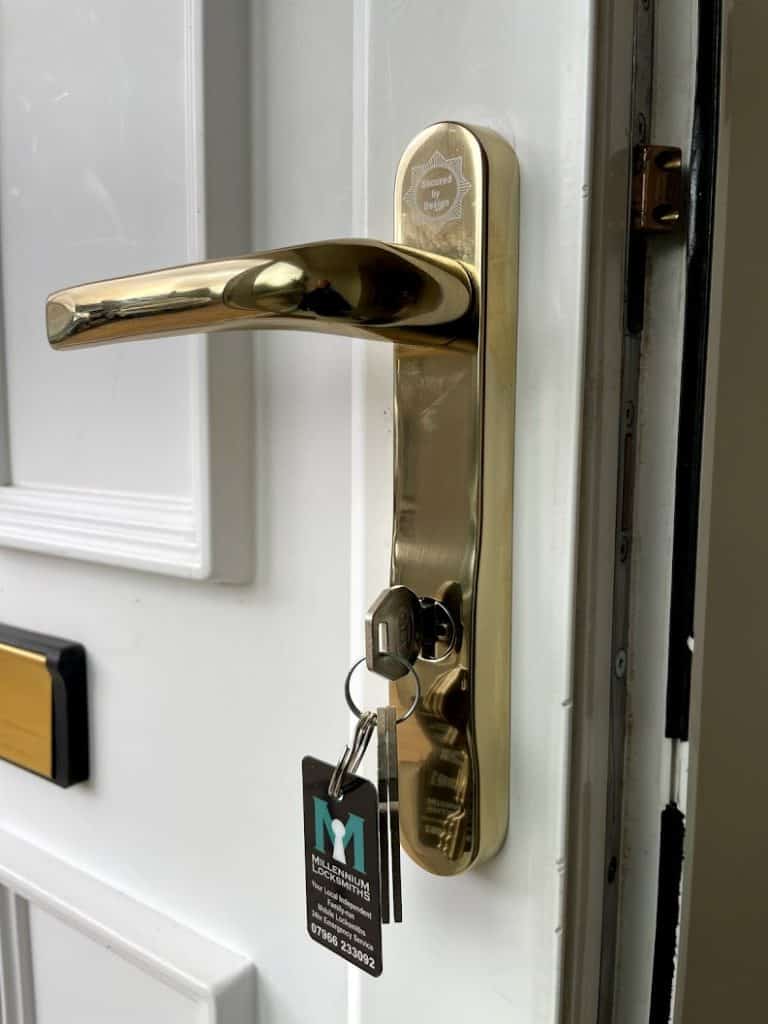
The cylinder is the barrel your key turns. If the handle lifts fine but the key won’t turn, or turns but doesn’t feel like it’s engaging, the cylinder is the likely culprit. Cylinders can wear, seize in cold or wet weather, or fail after someone has forced a key. They’re also the part worth upgrading for security, a cheap standard cylinder can be snapped in seconds, which is why an anti-snap replacement is often the sensible fix.
The tell-tale sign: handle works, key doesn’t, or the key is getting harder to turn.
3. The door has dropped or the frame has shifted
If your door only locks when you lift it on the handle, or pull it towards you, or give it a shove, the locking points are no longer lining up with the keeps in the frame. uPVC doors can drop very slightly on their hinges over time, and frames move a little with the seasons. When the alignment goes, the mechanism is fighting the frame every time you lock it, which then wears the mechanism out faster.
The tell-tale sign: it locks, but only if you lift, pull or lean on the door first.
What you can safely check yourself
There are a few sensible things to try before calling anyone, none of which risk making things worse:
- Try it with the door open. Lift the handle with the door standing open. If it lifts smoothly with the door open but not when closed, that points to alignment (culprit 3), not the mechanism.
- A tiny bit of the right lubricant. A little dry PTFE or graphite lubricant in the cylinder can free a stiff key. Avoid WD-40 and oil in the lock, they attract grime and cause more sticking later.
- Check the hinges. If the door is visibly catching on the frame or scraping the sill, it has probably dropped. Note it, but don’t start forcing hinge screws unless you know what you’re doing.
What I’d gently steer you away from is forcing anything. If the handle or key is stiff, the temptation is to push harder, but forcing a failing mechanism is the quickest way to turn a straightforward repair into a lockout. If it’s stiff, that’s the moment to sort it, not once it’s jammed solid.
The golden rule
Stiff is a warning, not an inconvenience. A uPVC door almost always gives you weeks of warning before it fails completely, in the form of a handle or key that’s getting harder to work. Dealing with it while it’s merely stiff is cheap and easy. Waiting until it jams usually means an emergency call-out and a door that won’t open or won’t lock. If yours is stiff, that’s the time.
When to call a locksmith
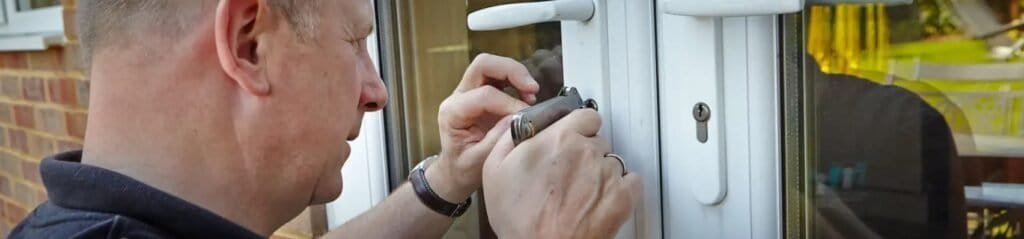
It’s worth a call when the handle won’t lift or has gone loose, when the key won’t turn, when the door only locks with a fight, or simply when you’d rather it was diagnosed properly before it lets you down. A good locksmith carries the common mechanisms, cylinders and handles on the van, so the vast majority of these are diagnosed and fixed in a single visit, without waiting for parts and without replacing anything that doesn’t need it.
One honest word of warning: if anyone recommends a whole new door before they’ve looked at the mechanism, get a second opinion. It’s very rarely necessary.
Common questions
uPVC door playing up?
Tim answers personally. No call-out charge, and most uPVC jobs are fixed on the first visit. He’ll tell you honestly what it needs.